
The Willow Tree Lesson
Reflections on technology, presence, and what feels real

In the second week of September, I spent my Tuesday morning next to the Spree — the river that runs through Berlin. The sun was warm, offsetting the chill from the strong breeze. I sat underneath a willow tree on one of the many wooden seats at Holzmarkt 25, a park/cultural center on the east side.
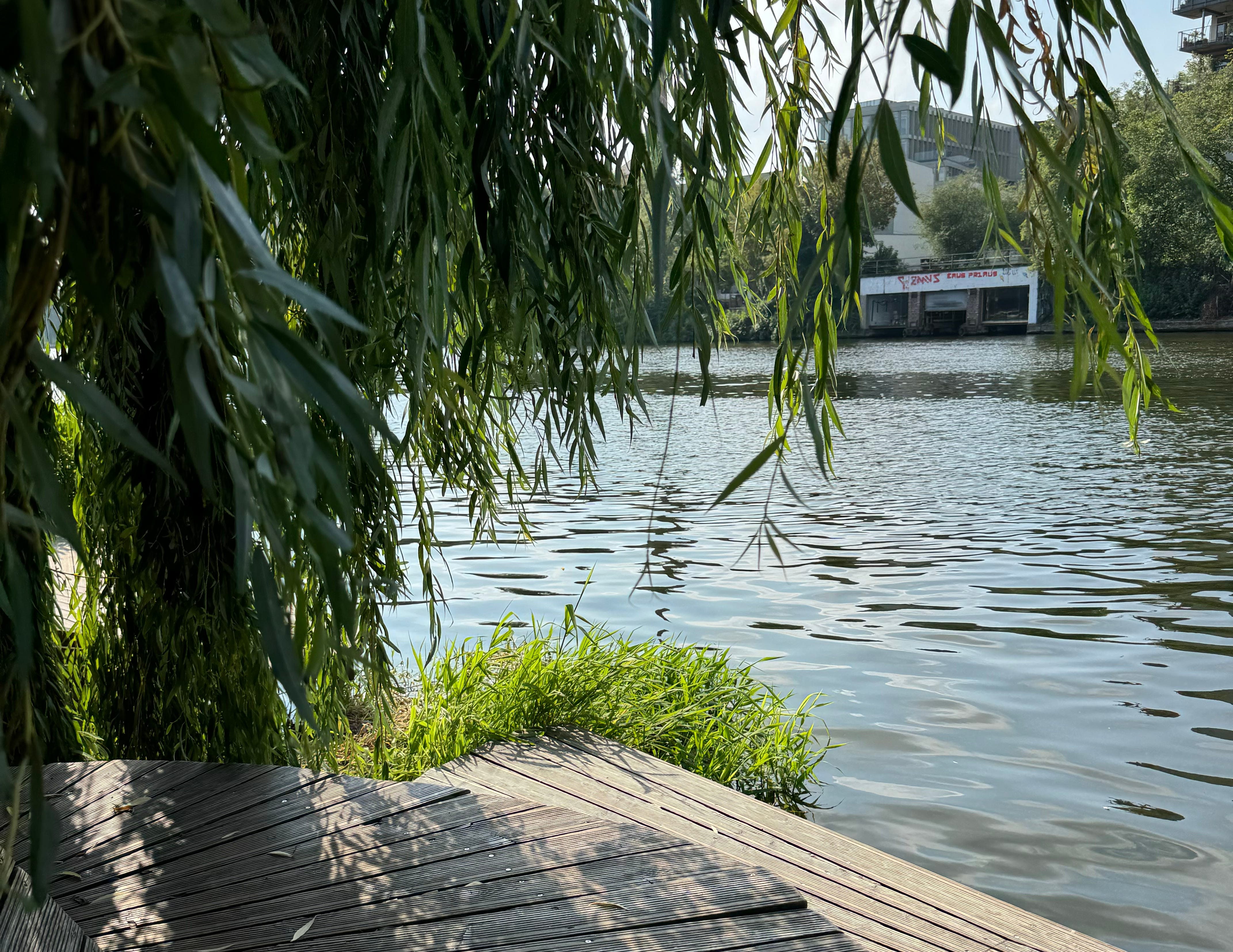
I watched the branches sway as I enjoyed pastries from the nearby bakery, and found myself in a moment of deep gratitude. I had never been to Germany before and was stopping through after spending time in Copenhagen. There are many past versions of me that would be in disbelief at the idea of my partner and I being able to travel like this. I was grateful for the sun, the water, the trees, the wind — I felt lucky to be existing in such a moment and knew it would stick with me.
As I was admiring the gift of the morning, a family came to sit just to my left, between me and the branches of the willow tree. It was a mother and her son and daughter in their early 20s. My initial reaction: frustration. Why, when there is so much space to sit, would they choose to sit between me and the beautiful view? And further, why sit just a foot away? Couldn’t they see I was enjoying a moment of peace?
I took a breath. It seemed they had been spending the morning exploring, like I planned to do for the remainder of the day. My next reaction: acceptance, and perhaps generosity. They deserved to enjoy this morning, too, right? It isn’t mine to claim; I am not owed peace.
This acceptance lasted a few moments. I felt good about being able to avoid sitting in frustration over something so silly. That was, however, until I noticed what the family was doing. Each person had their head tilted down, aimlessly scrolling on their phone. Frustration returned. Not only have they obstructed my view, but they weren’t even appreciating it. They weren’t seeing the moment playing out around them — the sun shining through the leaves, the water gently lapping the bank, ducks quickly swimming past. Instead, their minds sought consumption of another kind.
It’s not news to me, or you, that technology keeps us from experiencing the present moment. It wasn’t news to me as I watched it play out in front of me. But each moment like this, experienced or witnessed, chips away at the thick ice that has clouded my perspective. Each time, I become more aware of the scale of the impact. I sat in disbelief as I observed the family, and considered how many times I’ve been in their position. How many times have I missed the gifts in the world around me in favor for the chaos my phone provides?
“Every day is filled with opportunities to be amazed, surprised, enthralled—to experiencing the enchanting everyday. To stay eager. To be, in a word, alive.”
Rob Walker
This moment was, apparently, a final piece of a puzzle I’d been solving. It’s easy to watch a TikTok or read a post that provides enlightening insight — maybe it prompts a save or even a download. But most insights require personal experience in order to really sink in. In other words, you need to solve the puzzle even if many others have solved it before you.
For me, this puzzle was my relationship with technology, particularly my phone. I remember creating my “Twttr” account on my mom’s desktop computer in middle school and I’ve had every social app since. My high school years involved subtweeting, very serious curation of Instagram feeds, and seemingly endless scrolling on Tumblr. In those years, it didn’t feel unhealthy. It felt exciting and even beneficial — suddenly everyone had their own outlet (now I feel this is unfortunate).
For the past ten years, online environments have progressively worsened as the attention economy becomes more competitive. We’ve adopted the belief that we need to stay plugged in to “stay informed” and that creating separation can not only harm our social lives, but even our careers. This tether has skewed our understanding of what it means to live a meaningful life and has stunted our ability to socialize and communicate, each of us living in our own personal bubbles that provide as much hell as they do heaven.
As this has progressed in recent years, I’ve regularly assessed my relationship with my little screen I carry around. Does it harm me more than it helps me? But don’t I need to stay informed? Is this why I feel distant from friends, or will I feel more distant if I stop? Wait, how will people know I’ve gone to Germany if I’m not there to share it? (eye roll)
In tandem with this constant inner dialogue and assessment, I’ve found myself yearning for things that feel real, a life that feels real. Letters from friends, physical books and papers, presence in mundane activities, conversations with strangers, connection with nature. My moment on the river in Berlin brought on a collision between the yearning and the assessment, showing me very clearly that the answer to one lies in the other. Have I deleted all socials and thrown my phone out? No, and I likely won’t. But I have adopted a new perspective and understanding of what truly matters to me, and I’ve noticed many on the same journey.
As I write this, I’m sitting on the porch outside my apartment, listening to the wind in the trees and watching the cats in the windows watch the birds on the ground. While online it seems that the world is burning, I can see that the world in front of me is not.